



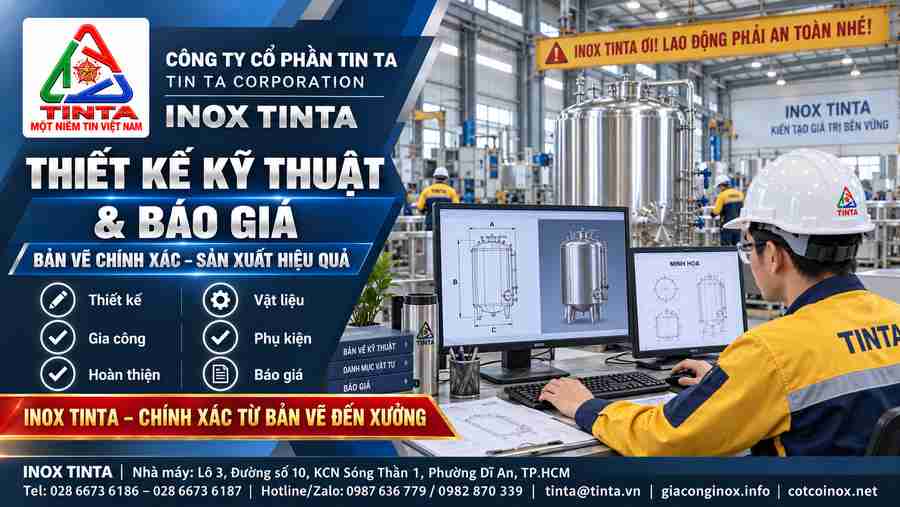
316 Industrial Stainless Steel Insulated Tank Fabrication 304
- Code: TT1461
- Manufacturer: VIETNAM TINTA CORPORATION
- Guarantee: Warranty For 10 Years
- Availability: Available – custom fabrication on request
- Price does not include VAT
Get a quote for your drawing or specification
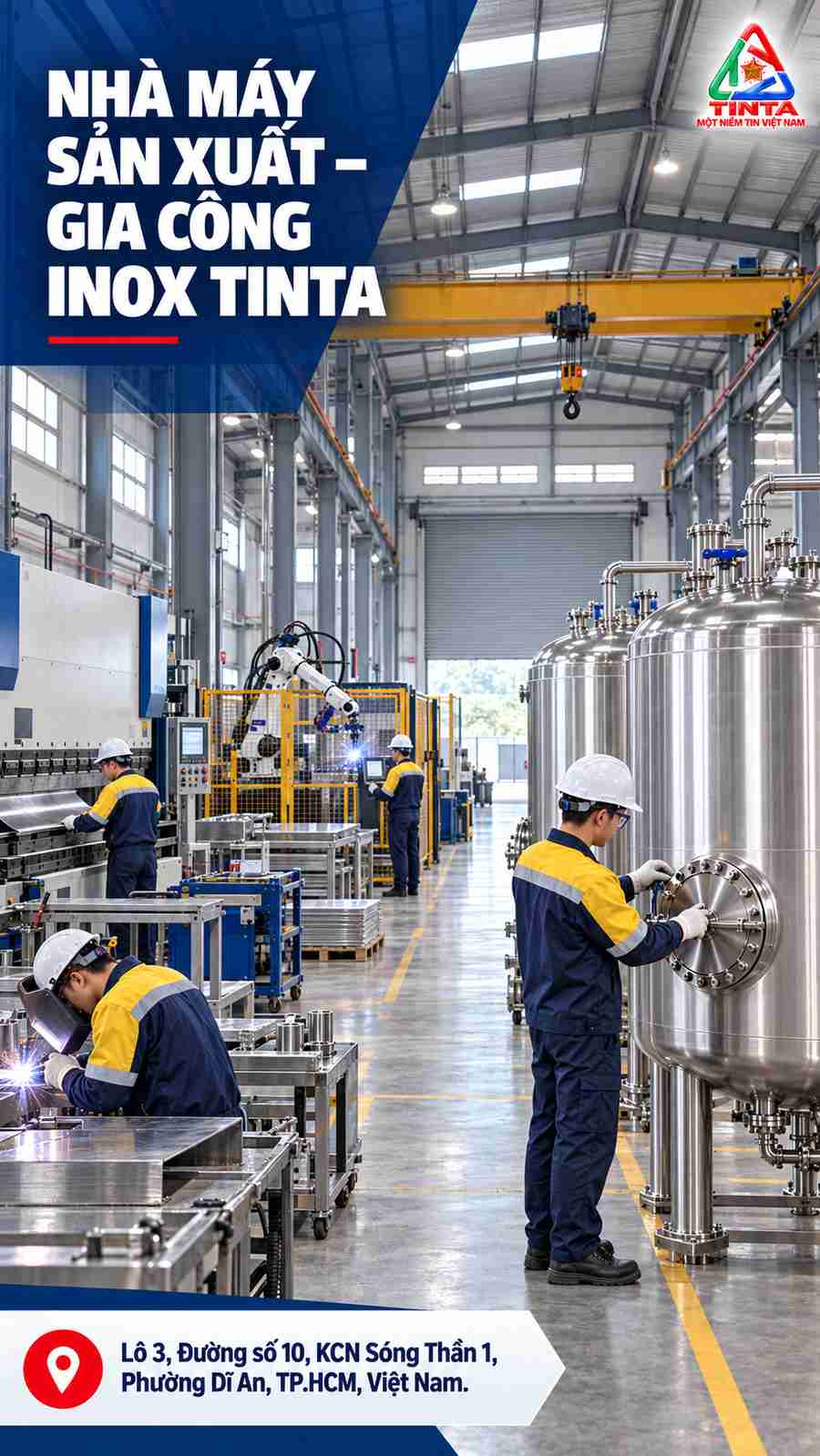
Own workshop: Lot 3, Road No. 10, Song Than 1 Industrial Park, Di An, Binh Duong
Product details
Industrial Stainless Steel Insulated Tank Fabrication 304 316
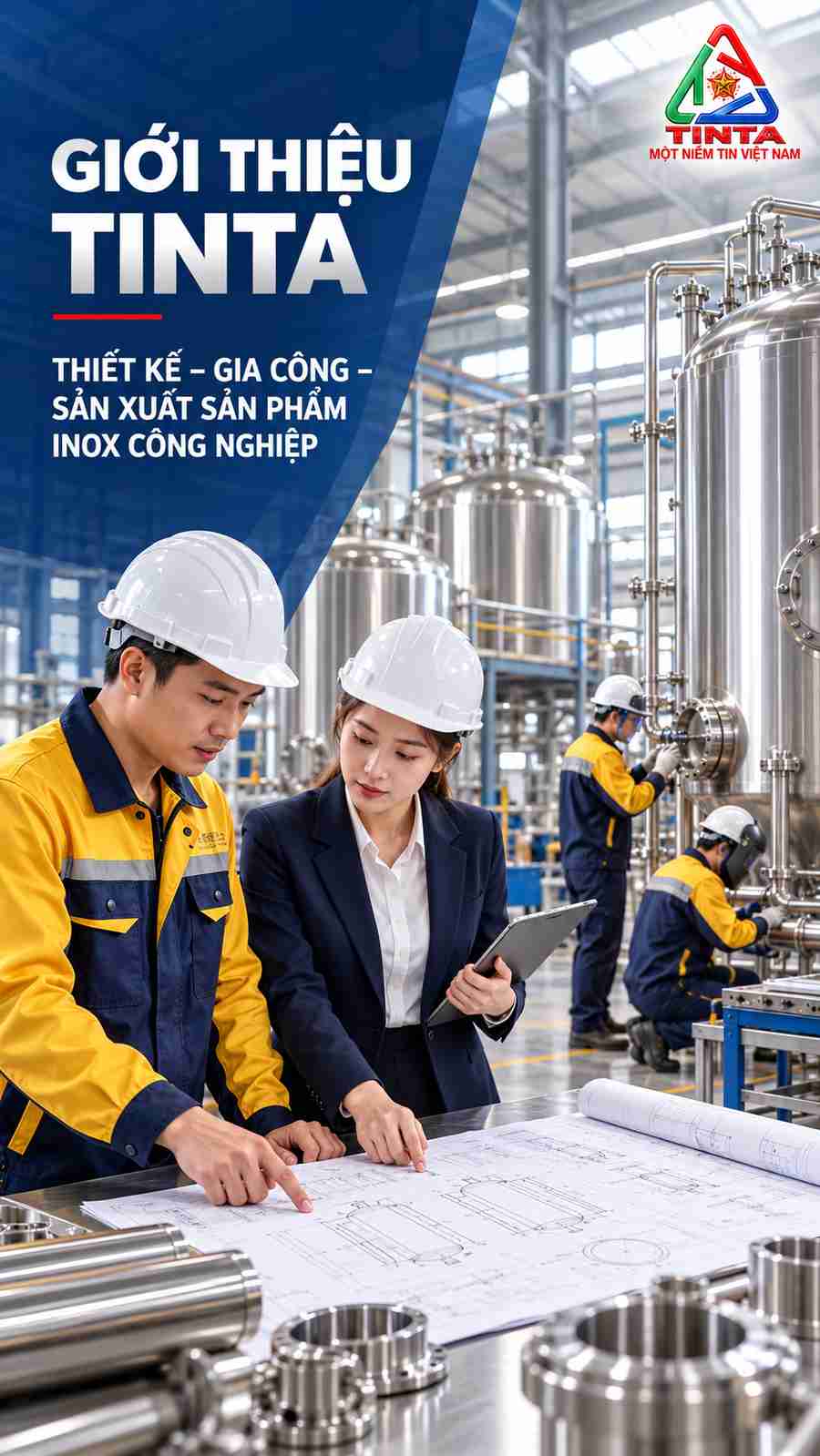
An industrial stainless steel insulated tank is not simply a stainless steel tank covered with insulation. Its actual performance depends on many technical factors, including material selection, tank design, thickness, welding, surface treatment, insulation, outer cladding, nozzles, manholes, supports, inspection and installation conditions.
⚠️ Buyers should not ask only: “How much does the tank cost?”
They should also ask:
What material is used? How is it designed? How is it welded? What insulation system is used? How are the welds treated? What inspections are performed before delivery?
Summary: This article explains 12 important technical factors buyers should consider when purchasing 304/316 stainless steel insulated tanks. It is designed as a practical checklist to help industrial buyers avoid choosing a tank based only on appearance or low price while overlooking material quality, welding, insulation, structural design and inspection requirements.
1. Identify the Stored Medium Before Choosing Stainless Steel
☑️ This should be the first question.
Before requesting a quotation for an industrial stainless steel insulated tank, clearly define what the tank will contain:
-
Hot water
-
Clean water
-
Process water
-
Food products
-
Beverages
-
Industrial liquids
-
Chemical solutions
-
Chloride-containing liquids
-
Corrosive media
-
High-temperature media
❗ There is no single stainless steel grade that is ideal for every application.
Material selection should consider the stored medium, concentration, temperature, exposure time and surrounding environment.
⚠️ The buyer should provide the manufacturer with the actual operating conditions before the tank is designed.
2. Stainless Steel 304 or 316: Which One Is Better?
✅ 304 stainless steel is widely used for many industrial and processing applications.
✅ 316 stainless steel contains molybdenum, which generally provides better resistance to corrosion in chloride-containing environments.
The real question is not simply:
“Is 316 better than 304?”
The better question is:
“Does my application require the additional corrosion resistance of 316?”
⚠️ Do not automatically pay for 316 when 304 is technically adequate.
⚠️ But do not choose 304 only because it is cheaper when the operating environment requires higher corrosion resistance.
3. Do Not Ask Only What Stainless Steel Is Used
❗ “304 stainless steel” alone is not enough information.
The buyer should clarify:
-
What grade is used for the product-contact surface?
-
What grade is used for the external shell?
-
What material is used for pipes and fittings?
-
What material is used for valves and flanges?
-
Is the material clearly stated in the quotation?
-
Is the material specified in the technical drawing?
-
Can material documentation be provided when required?
⭐ This is one of the hidden reasons why two apparently similar tanks can have very different prices.
4. Thicker Stainless Steel Is Not Always Better
⚙️ This is a common misunderstanding.
Tank thickness should be determined according to the tank dimensions, structural requirements, operating conditions, loads and pressure requirements where applicable.
An unnecessarily thin tank may cause:
❌ Deformation
❌ Structural problems
❌ Reduced service life
An unnecessarily thick tank may cause:
❌ Higher cost
❌ Higher weight
❌ More difficult fabrication and transportation
⚠️ For pressure equipment, the engineering requirements are considerably more stringent and the applicable design code must be identified before fabrication.
The buyer should therefore avoid using a fixed thickness for every tank.
5. Weld Quality Is Critical to Tank Life
⚒️ Non-technical buyers often judge a tank by how shiny it looks.
Experienced engineers pay close attention to the welds.
Important factors include:
-
Welding process
-
Weld geometry
-
Weld continuity
-
Surface defects
-
Heat-affected areas
-
Post-weld treatment
-
Inspection methods
✅ A visually attractive weld does not automatically mean a technically good weld.
For stainless steel, improper welding and heat exposure can negatively affect the surface condition and corrosion resistance.
6. Post-Weld Cleaning and Passivation Matter
❗ This is one of the technical details many buyers never ask about.
After stainless steel welding and fabrication, the surface may contain heat tint, contamination or iron particles introduced during manufacturing.
Appropriate surface treatment can help restore the corrosion-resistant condition of stainless steel.
☑️ Ask the manufacturer:
“How are the stainless steel welds cleaned and treated after welding?”
Do not ask only:
“Does the weld look good?”
A professional fabrication process considers both weld appearance and surface condition.
7. Insulation Is as Important as the Tank Shell
❄️ Many buyers focus entirely on stainless steel and forget that the purpose of an insulated tank is also to control heat loss.
The insulation system should be evaluated based on:
-
Insulation material
-
Operating temperature
-
Insulation thickness
-
Thermal performance
-
Moisture resistance
-
Mechanical protection
-
Maintenance requirements
⚠️ “Thicker insulation is always better” is not necessarily correct.
The appropriate thickness should be determined according to the operating temperature, insulation material, environmental conditions and required thermal performance.
8. The Outer Cladding Must Protect the Insulation
☀️ The external shell is not only for appearance.
A properly designed outer cladding should help:
-
Protect the insulation
-
Reduce water penetration
-
Improve durability
-
Provide a clean external finish
-
Protect the insulation system during operation and maintenance
⚠️ One important concern is moisture entering the insulation system.
When insulation becomes wet, its thermal performance can be reduced.
Therefore, the outer cladding and joints should be designed with the operating environment in mind.
9. Manholes, Nozzles and Connections Must Be Planned
⚙️ When reviewing an industrial stainless steel insulated tank quotation, do not look only at the main shell.
Pay attention to:
-
Manholes
-
Cleaning openings
-
Inlet connections
-
Outlet connections
-
Drain connections
-
Vent connections
-
Return lines
-
Valves
-
Flanges
-
Temperature sensor connections
-
Level instrumentation connections
❗ Their positions should match the process, cleaning procedure, maintenance requirements and available installation space.
A beautifully fabricated tank can still cause problems if the nozzle arrangement is wrong.
Possible consequences include:
⛔ Difficult maintenance
⛔ Difficult cleaning
⛔ Valve access problems
⛔ Pipe modification at site
⛔ Additional installation costs
✅ A proper technical drawing should therefore be reviewed before production.
10. Tank Supports and Loads Must Be Considered
⛓️ For large tanks, support design becomes increasingly important.
The buyer should consider:
-
Tank supports
-
Support rings where applicable
-
Base structure
-
Operating weight
-
Full-load weight
-
Local loads
-
Transportation requirements
-
Site installation conditions
For vertical tanks, the support structure must be appropriate for the actual operating load and installation arrangement.
❗ A high-quality tank is not simply a good-looking shell. It is a complete engineered structure.
11. Inspection Should Be Defined Before Delivery
☑️ Inspection requirements should be clarified before the order is placed.
Depending on the tank type and project requirements, inspection may include:
-
Overall dimensions
-
Visual appearance
-
Weld condition
-
Leak tightness
-
Nozzle and connection positions
-
Accessories
-
Surface finish
-
Insulation condition
-
Packaging condition
For pressure equipment, inspection and testing requirements can be governed by the applicable pressure-vessel code and project specifications.
✅ Buyers should ask exactly:
“What inspections and tests are included before delivery?”
This is much better than accepting a general statement such as:
“Quality checked.”
12. The Lowest Price Is Not Always the Lowest Cost
❗ Two tanks with the same:
capacity + dimensions + stainless steel grade
may still have very different prices because of differences in:
-
Engineering
-
Material thickness
-
Stainless steel quality
-
Structural design
-
Welding quality
-
Post-weld treatment
-
Insulation material
-
Insulation thickness
-
Outer cladding
-
Valves and fittings
-
Supports
-
Inspection
-
Technical documentation
-
Packaging
-
Transportation
-
Installation
⭐ Therefore, always compare the same technical scope, not only the final quotation price.
Buyer Checklist: 12 Questions Before Ordering
❓ 1. What medium will the tank store?
❓ 2. What is the operating temperature?
❓ 3. Is the tank atmospheric or pressurized?
❓ 4. Should the tank use 304, 304L, 316 or 316L stainless steel?
❓ 5. How is the required material thickness determined?
❓ 6. What welding process will be used?
❓ 7. How will the welds be cleaned and treated?
❓ 8. What insulation material and thickness will be used?
❓ 9. How is the insulation protected by the outer cladding?
❓ 10. Where are the manholes, nozzles and connections located?
❓ 11. What inspections and leak tests are performed before delivery?
❓ 12. What technical documents will be provided with the tank?
When Should You Choose Stainless Steel 304 or 316?
✅ 304 stainless steel can be considered when the operating environment and stored medium are compatible with its corrosion-resistance characteristics.
✅ 316/316L stainless steel may be more appropriate when higher corrosion resistance is required, particularly in environments involving chloride exposure.
⚠️ The final decision should be based on:
Medium + concentration + temperature + environment + operating conditions + engineering requirements
—not simply the product label “304” or “316”.
A Good Insulated Tank Starts With a Good Design
✏️ A professional manufacturer should not receive only a request such as:
“I need a 10,000-liter tank.”
A proper technical discussion should cover:
Medium → temperature → pressure → dimensions → material → structure → insulation → nozzles → fittings → installation conditions → inspection → documentation
⚙️ This is the difference between basic tank fabrication and engineered stainless steel tank fabrication according to application requirements.
INOX TINTA – Industrial Stainless Steel Solutions
CÔNG TY CỔ PHẦN TIN TA
TIN TA CORPORATION
Brand: INOX TINTA
✅ Head Office: 68 Nguyen Hue Street, Sai Gon Ward, Ho Chi Minh City, Vietnam
✅ Factory: Lot 3, Road No. 10, Song Than 1 Industrial Park, Di An City, Binh Duong Province, Vietnam
☎️ Tel: +84 28 6673 6186 – +84 28 6673 6187
☎️ Hotline / Zalo: +84 987 636 779
✉️ Email: tinta@tinta.vn
✅ Websites: giaconginox.info | cotcoinox.net
INOX TINTA focuses on stainless steel design, fabrication and manufacturing according to industrial requirements, including industrial stainless steel insulated tanks developed according to specific application and technical conditions.
304 vs 316 Stainless Steel Insulated Tanks SEO Keywords
industrial stainless steel insulated tank, 304 stainless steel insulated tank, 316 stainless steel insulated tank, industrial stainless steel heat insulated tank, stainless steel thermal insulation tank, industrial insulated water tank, custom stainless steel insulated tank, stainless steel insulated tank manufacturer, 304 vs 316 stainless steel tank, stainless steel hot water storage tank, industrial stainless steel storage tank, custom stainless steel tank fabrication, stainless steel tank welding process, stainless steel tank post-weld treatment, stainless steel tank insulation system, industrial tank quality inspection, stainless steel tank technical design, food grade stainless steel insulated tank, stainless steel insulated tank manufacturer Vietnam, INOX TINTA stainless steel tanks
INOX TINTA – INDUSTRIAL STAINLESS STEEL SOLUTIONS
Similar products









- Business staff 0974194339 Hoàng Gia Phú (Mr)
- Sales support 0987636779 Mr Ng. Sáu (Vi / Eng)
- Technical support 0982870339 Mr H. Thái (Vi / Eng)
- TINTA Reception 028 66736186 Ms Thùy Dung