



Bending, punching and stamping
Bending, punching and stamping
Products in this category


Stainless steel cutting, bending, punching, stamping and rolling
Turning a flat stainless sheet into an electrical cabinet, a tray, a gutter, a bracket or a perforated panel takes cutting, bending, punching, stamping and rolling. Inox TINTA handles each operation separately or the whole job to your drawing, in 201, 304 and 316 stainless steel and mild steel, from prototypes to large orders.
When is each operation used?
| Operation | Purpose | Typical parts |
|---|---|---|
| Cutting (fiber laser, shearing) | Flat blanks of the right shape | Base plates, flanges, cabinet blanks |
| Bending (CNC press brake) | Accurate straight-line folds | Cabinets, gutters, U and V channels, trays |
| Punching | Many repeated holes | Round, square or slotted perforated sheet, filters, grilles |
| Stamping (dies) | Embossing, ribs, high-volume parts | Caps, covers, stiffening ribs |
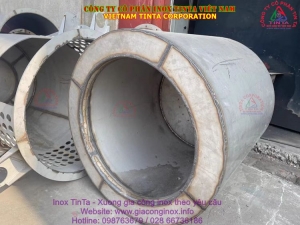
| Rolling | Curves, cylinders, cones | Tank shells, curved handrails, tapered tubes |
Design tips for bent stainless parts
- Inside bend radius is usually close to the sheet thickness; a smaller radius can crack the outer surface on thick sheet.
- Minimum flange length must be long enough to sit on the die; very short flanges need another approach (corner relief, or bend before cutting).
- Stainless springs back more than mild steel, so the angle is over-bent; we bend a first-off part before the batch.
- Holes near a bend deform; keep them about 2–3 times the thickness away from the bend line, or punch after bending.
- Cosmetic finishes (hairline, mirror): keep the protective film on and mark the visible face on the drawing.
Choosing a perforated stainless sheet
Perforated sheet is defined by hole shape (round, square, slot, hexagon), hole size and pitch (centre distance), which together give the open area. Small, close holes give a stiffer, more closed sheet; large, wide-spaced holes let more air and water through but weaken the sheet. Tell us the purpose (filtering, guarding, decoration, ventilation) and we will suggest a pattern.
Blanks are usually fiber laser cut before bending; finished parts can be welded, polished or PVD gold coated. Dished tank heads are covered on our metal spinning and dished heads page.
Frequently asked questions
Do you bend small quantities or a single prototype?
Yes. CNC bending needs no product-specific die, so prototypes are fine. Die stamping pays off when the quantity is large enough to cover the die cost.
What do you need for a quote?
A drawing with finished dimensions (or a 3D file), grade, thickness, finish, quantity and any welding or polishing requirements.
Does 304 stainless crack when bent?
Grade 304 is ductile and bends well with a suitable radius. For thick sheet or tight radii we recommend a safe radius before production.
Get a quote the same day: send your drawing (DXF, DWG, PDF or a dimensioned photo), stainless grade, thickness and quantity to tinta@tinta.vn or on Zalo/WhatsApp +84 987 636 779. Our engineers check the drawing and call you back to agree on the details.
Related services & categories












- Business staff 0974194339 Hoàng Gia Phú (Mr)
- Sales support 0987636779 Mr Ng. Sáu (Vi / Eng)
- Technical support 0982870339 Mr H. Thái (Vi / Eng)
- TINTA Reception 028 66736186 Ms Thùy Dung